History often treats whistleblowers harshly in their own time. Governments call them traitors. Institutions label them threats. Only later does the public recognize what they actually were: people who refused to stay silent when the law was being violated in secret.
Edward Snowden belongs squarely in that tradition.
He did not sell secrets to a foreign power. He did not expose troop movements or endanger lives. What he revealed was something far more unsettling to those in power: proof that the United States government had built a vast, secret surveillance apparatus that operated far beyond the limits of the Constitution — and lied about it to the American public.
Snowden did what the system was designed to prevent. He made citizens aware of how thoroughly they were being watched.
The Moment That Changed Everything
In 2013, Edward Snowden was a systems administrator and contractor with deep access to classified systems. He was not a policymaker. He was not an activist. He was a technologist — the kind of person who understands how systems actually work, not how they are described in public hearings.
What he saw disturbed him.
Snowden discovered that surveillance programs repeatedly described to Congress as “targeted,” “limited,” or “lawful” were, in reality, sweeping, indiscriminate, and global. They collected information on millions of Americans who were not suspected of any crime.
And they were doing it in secret.
The Programs Snowden Exposed — And Why They Mattered
PRISM: Direct Access to the Digital Lives of Americans
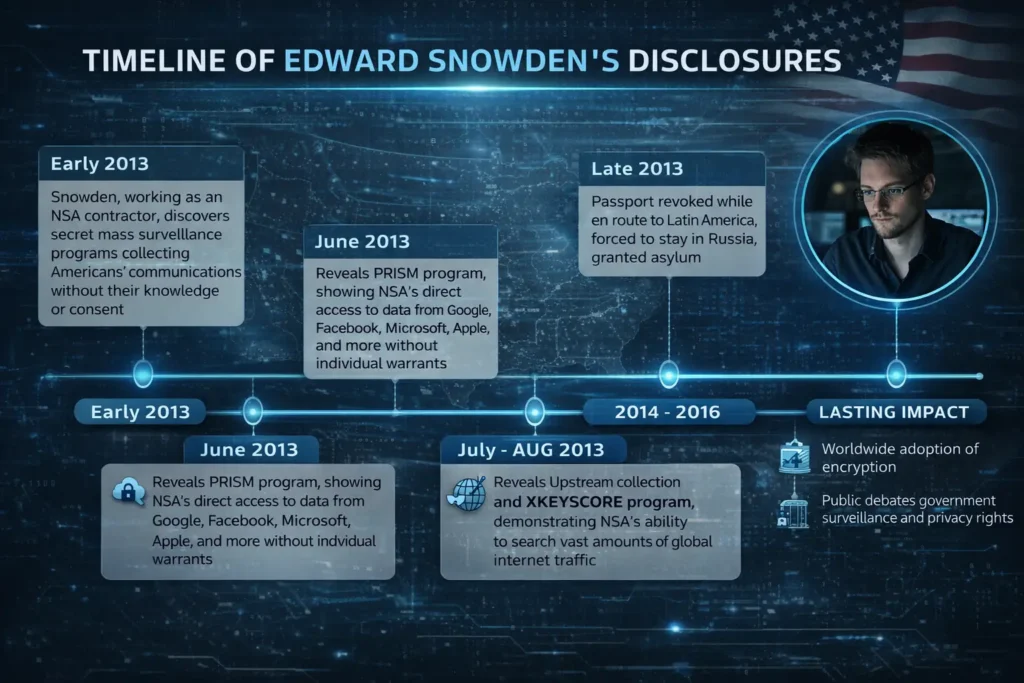
PRISM was one of the most alarming programs Snowden revealed. It allowed the National Security Agency to collect emails, video chats, photos, stored data, and communications from major technology companies.
The public had been told that the government needed warrants. That surveillance was targeted. PRISM showed otherwise.
This program demonstrated that the backbone of the modern internet had been quietly integrated into intelligence collection — without meaningful public consent.
Bulk Telephone Metadata Collection
For years, U.S. officials denied collecting phone records on Americans. Snowden proved that was false.
Under this program, the government collected metadata on every phone call — who called whom, when, and for how long. While officials argued this wasn’t “content,” metadata is often more revealing than content itself. It maps relationships, movements, habits, and associations.
This was mass surveillance by definition.
XKEYSCORE: Search the World’s Communications
XKEYSCORE was not about storage — it was about power.
This system allowed analysts to search vast streams of global internet traffic in near real time. Emails, chats, browsing histories — all potentially searchable with minimal oversight.
It meant the infrastructure existed to monitor almost anyone, anywhere, at any time.
That capability alone should have alarmed the public. It did — but only after Snowden made it known.
Upstream Collection: Tapping the Internet Itself
Snowden also revealed that the NSA was intercepting data directly from fiber-optic cables — the physical arteries of the internet.
This wasn’t targeted spying. It was vacuuming traffic at scale, including communications of Americans, journalists, lawyers, and activists.
The Fourth Amendment was not designed to survive this kind of power unchecked.
Why Snowden Didn’t “Go Through Proper Channels”
Critics often argue that Snowden should have reported concerns internally. This argument ignores reality.
Snowden watched previous whistleblowers — people who followed internal processes — be destroyed professionally, prosecuted, or silenced. The intelligence community’s internal reporting mechanisms were not designed to stop illegal surveillance; they were designed to contain dissent.
Going public was not reckless. It was the only option left.
The Media, Not Snowden, Decided What Was Released
Snowden did not dump documents online. He worked with journalists. He insisted on responsible disclosure. Media organizations vetted materials, withheld sensitive operational details, and focused on programs that raised constitutional questions.
That distinction matters.
The damage done was not to national security. It was to unchecked secrecy.
Why Snowden Had to Leave — And Why He Could Not Return
After the disclosures, the U.S. government charged Snowden under the Espionage Act — a law that does not allow defendants to argue motive, public interest, or constitutional necessity.
In other words, Snowden would not have been allowed to explain why he acted.
Faced with certain imprisonment and a show trial stripped of context, Snowden fled. His path eventually left him stranded in Russia — not because he chose it, but because his passport was revoked mid-journey.
Exile was not the goal. Survival was.
What Snowden Changed — Permanently
Because of Snowden:
- Courts ruled that mass phone metadata collection was unlawful
- Surveillance authorities were forced into public debate
- Encryption became mainstream
- Technology companies hardened security
- The public learned the truth about digital surveillance
These are not the outcomes of betrayal. They are the outcomes of accountability.
Patriotism Is Not Blind Obedience
Snowden’s critics often redefine patriotism as silence.
But the United States was founded on resistance to unchecked power. The Constitution does not exist to protect the government from the people — it exists to protect the people from the government.
Snowden understood that.
He chose principle over comfort. Law over loyalty. Truth over obedience.
That is not treason.
That is courage.
The Legacy Still Being Written
Edward Snowden remains in exile not because he harmed the United States — but because he exposed what the United States was becoming behind closed doors.
History has a habit of vindicating those who defend liberty when it is inconvenient to do so.
Snowden did not weaken democracy. He forced it to look in the mirror.
And that may be the most American act of all.